JCmyONE Baby Store
Stage 1 to Stage 4 - Books - Early Learning By Visual Card - 0 to 3Y - High Contrast Black & White Baby Visual Learning Card Main
Stage 1 to Stage 4 - Books - Early Learning By Visual Card - 0 to 3Y - High Contrast Black & White Baby Visual Learning Card Main
Couldn't load pickup availability
💫 About This Book
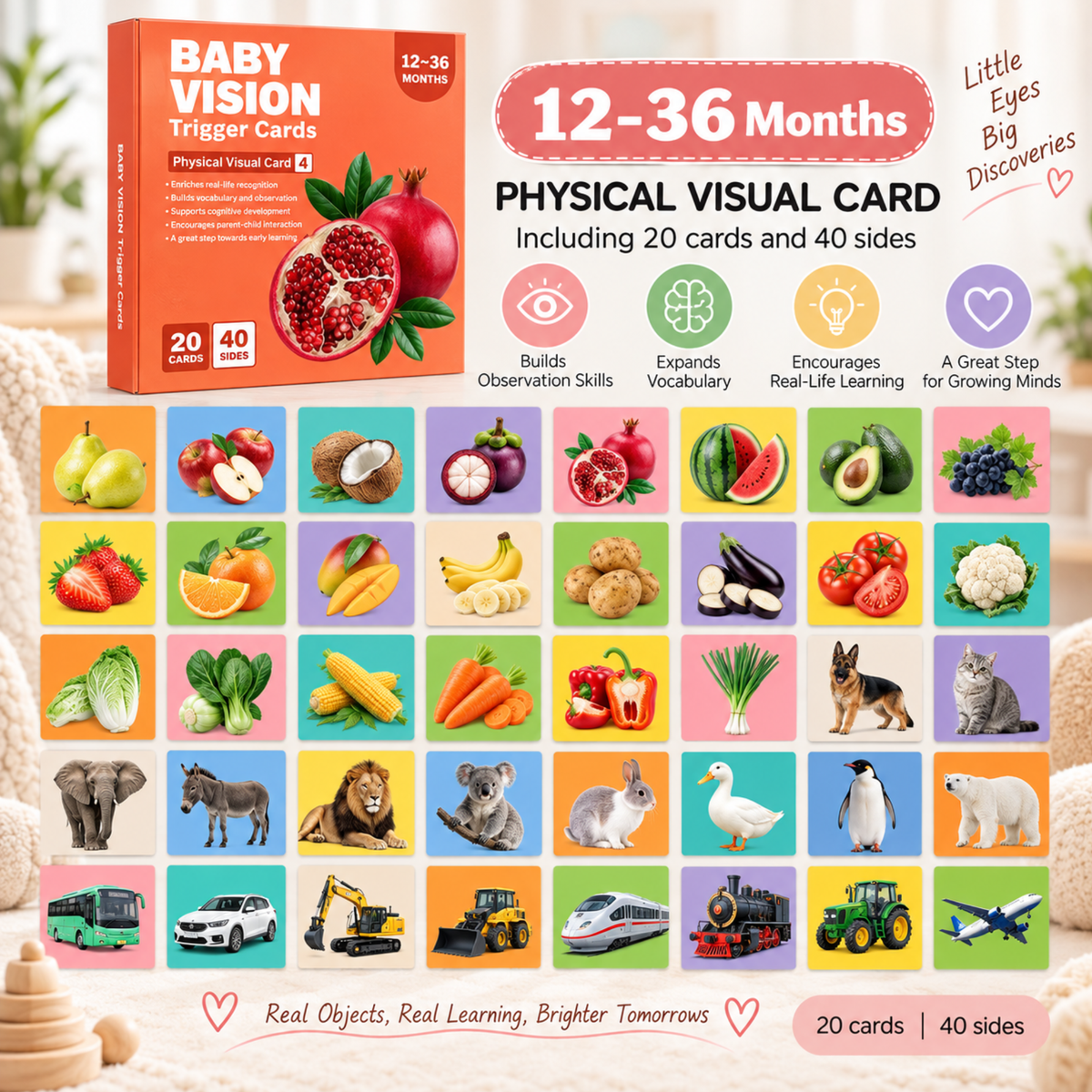
These high-contrast visual cards are carefully selected to introduce babies and young children to simple images, shapes and visual patterns through parent–child interaction.
The black-and-white designs give young babies clear images to observe during supervised lying-down play, tummy time or quiet time with a parent. As babies grow, parents can gradually use the cards to introduce picture names, familiar objects and simple words, turning early visual exploration into interactive learning.
🌱 Progressive Learning Stages - Newborn to 36 Months
NOTE: The stages below are a flexible guide for playful parent-child learning, not milestones that every baby must achieve by a particular age. Every baby develops differently, so mothers can follow their baby’s interests, comfort and natural pace without pressure.
Approximately 1–3 Months - Stage 1: Visual Discovery
• Show one high-contrast card at a time while your baby is awake and calm.
• Position the card within a comfortable viewing distance and allow time for your baby to observe the image.
• Slowly move the card from side to side to encourage gentle visual tracking.
• Keep each activity brief and stop when your baby looks away or becomes unsettled.
Approximately 3–6 Months - Stage 2: Looking and Following
• Introduce different cards one at a time during supervised play.
• Slowly move a card across your baby’s field of view and allow their eyes to follow it.
• Place a card nearby during supervised tummy time to encourage your baby to look towards the picture.
• Begin naming simple pictures using a calm and familiar voice.
Approximately 6–12 Months - Stage 3: Looking, Reaching and Recognizing
• Place two familiar cards within view and observe which picture attracts your baby’s attention.
• Name the pictures repeatedly during shared play.
• Encourage your baby to look or reach towards a card when you name its picture.
• Repeat familiar cards regularly before introducing additional images.
Approximately 12–24 Months - Stage 4: Pointing and Naming
• Place a small selection of familiar cards in front of your child.
• Ask simple questions such as “Where is the cat?” and allow time for your child to respond.
• Encourage pointing, gestures, sounds or attempts at saying the picture’s name.
• Introduce simple descriptive words that relate to familiar pictures.
Approximately 24–36 Months - Stage 5: Words and Simple Connections
• Encourage your child to name familiar pictures independently.
• Ask simple questions about what they see on each card.
• Introduce short phrases that connect the picture with something familiar, such as “The cat says meow.”
• Invite your child to choose a card and tell you something about the picture in their own way.
🧸 Toys That Pair Well With This Book’s Learning
👩👧 Parent Guidance: Begin with one toy that matches your child’s current age and ability. Demonstrate one activity at a time and repeat it until your child participates with greater confidence and requires less assistance.
If several toys are available, observe which one interests your child most, begin with that toy and gradually introduce the others as your child is ready.
🧸 Toys - Activity Play Mat (1m–12m)
Why it pairs well:
Creates a supervised play area where parents can position the visual cards within baby’s comfortable viewing range.
Encourages baby to:
Look towards pictures, follow visual patterns and gradually reach towards cards during supervised play.
2. 🔔 Toys - Rattle (3m–12m)
Why it pairs well:
Adds a sound element that parents can use alongside the visual cards to attract baby’s attention during shared activities.
Encourages baby to:
Look towards a sound, shift attention between the rattle and card, and practise reaching and grasping.
3. ⚽ Toys - Sensory Balls (6m–18m)
Why it pairs well:
Provides a physical object baby can hold and explore while parents introduce related words, shapes or descriptions from the visual cards.
Encourages baby to:
Look, touch, hold and begin connecting spoken words with objects experienced during play.
4. 🎵 Toys - Sensory Sound Toy (3m–18m)
Why it pairs well:
Combines sound with the visual attention encouraged through the cards, giving parents another way to make shared learning interactive.
Encourages baby to:
Listen, look towards different sources of stimulation and respond to sounds during parent–child play.
5. 🪞 Toys - Tummy Time Mirror (1m–12m)
Why it pairs well:
Allows parents to alternate between baby’s reflection and high-contrast visual cards during supervised tummy time.
Encourages baby to:
Observe faces, notice visual differences and gradually become familiar with simple facial features.
6. ☁️ Toys - Tummy Time Pillow (1m–12m)
Why it pairs well:
Provides supervised positioning support while parents display individual visual cards within baby’s view.
Encourages baby to:
Lift their head, focus on a picture and look between different cards during tummy-time activities.
7. 💧 Toys - Tummy Time Water Cushion (3m–12m)
Why it pairs well:
Introduces moving visual elements alongside the still images presented on the learning cards.
Encourages baby to:
Follow movement, shift visual attention and listen as parents describe what baby can see.
🌟 How Adding a Toy Can Help:
A matching toy helps baby connect an image on a visual card with something they can see, touch, hear or hold during supervised play.
This can support baby’s understanding that pictures can represent familiar objects and ideas. As parents repeatedly name both the picture and the object, children can gradually begin connecting what they see with the words they hear.
✅ Ready for the next stage when:
Progress when the child consistently shows interest in familiar cards and begins responding to them through looking, reaching, pointing, gestures, sounds, words or short phrases.
⚠️ Legal & Safety Disclaimer
Product information is provided to the best of our knowledge. Please always refer to the actual product packaging and the JCmyONE Terms & Conditions for complete product information, care instructions, and safety guidance.